




A Guide to Rugby League Dimensions, Sizes and Markings: Everything you ever needed to know

Are you a groundskeeper for a community rugby club? Or are you responsible for providing rugby facilities in a school? Maybe you play an instrumental role within a sporting organisation… or you might simply be a huge fan of rugby.
Whatever your association with this exciting game, you'll find here everything you need to know about the dimensions and markings of a standard adult-sized rugby league pitch.
Rugby League Pitch Dimensions
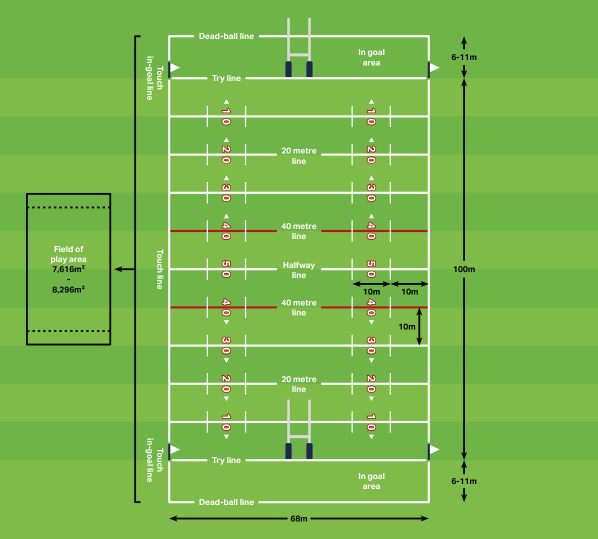
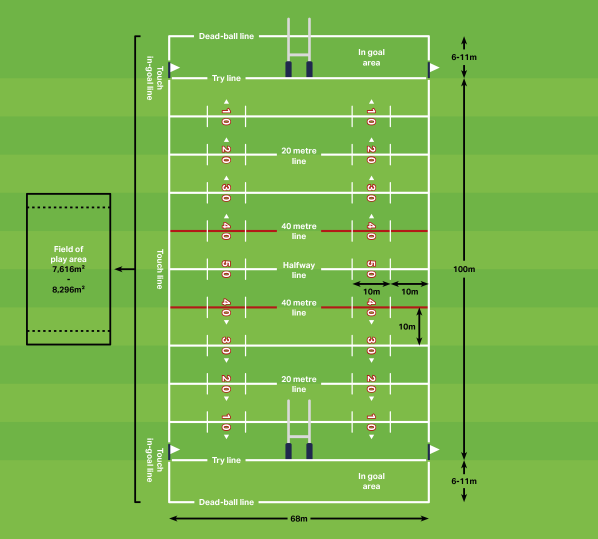
A rugby league pitch (or field) is 68m wide and 112-122m long. The try lines (or goal lines) stand 100m apart and on each one is a goal post that's at least 16m high and 5.5m wide, with a crossbar 3m above the ground. The distance from try line to dead-ball line is 6-11m.
How long is a rugby league pitch?
The field of play on a full-size rugby league pitch is 100m long. This counts as the rectangular area between try lines – the lines on which the goal posts are placed – and is 68m wide. Unlike the field of play, which is a fixed length, the full pitch including the in-goal area is a minimum of 112m and a maximum of 122m long.
How wide is a rugby league pitch?
A full-size rugby league pitch will always be 68m wide, although the size of the field can vary in length.
What is the area of a rugby league pitch?
The length of a rugby league pitch varies between 112m and 122m, which means the total area will be anything from 7,616m 2 to 8,296m2. With variation occurring solely beyond the try lines, this has no effect on the field of play and so the difference in area is not significant.
It should be noted, though, that these area dimensions are in fact a little larger than the actual playing area. The Rugby League International Federation defines the playing area as "the area bounded by, but not including, the touchlines and dead-ball lines". This means that all lines are touch – i.e. out of play.
Rugby league pitch dimensions in feet
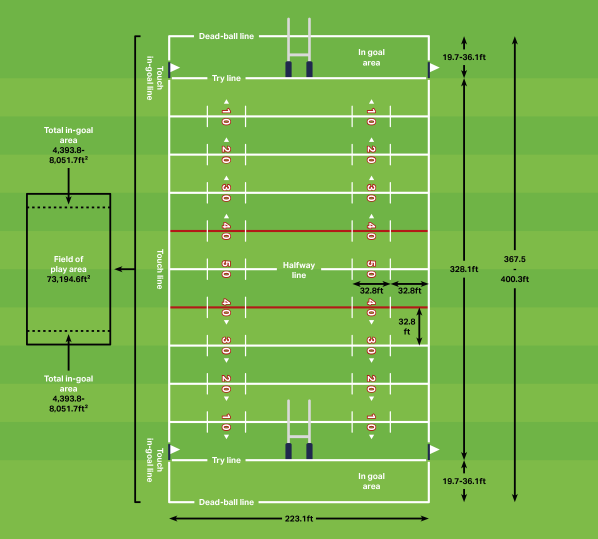
Here are the dimensions in feet for a rugby league pitch:
- Touchline to touchline (width): 223.1ft
- Dead-ball line to dead-ball line (total length): 367.5-400.3ft
- Try line to try line (field of play): 328.1ft
- Field of play area: 73,194.6ft2
- Try line to dead-ball line (in-goal area): 19.7-36.1ft
- Total in-goal area: 4,393.8-8,051.7ft2.
Rugby league pitch dimensions in yards
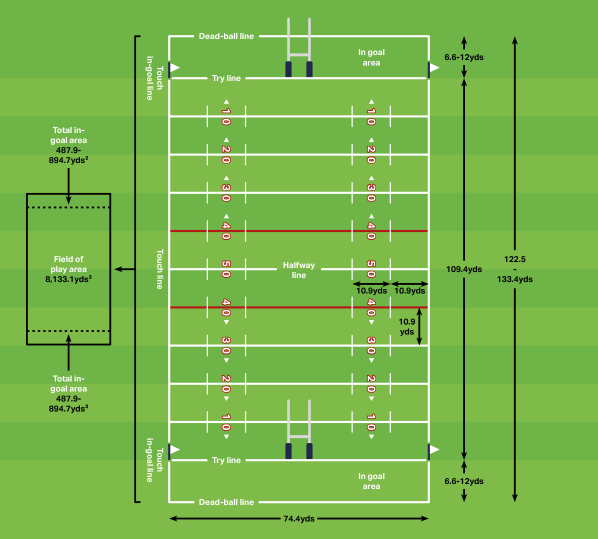
In yards, rugby league pitch dimensions are:
- Touchline to touchline (width): 74.4yds
- Dead-ball line to dead-ball line (total length): 122.5-133.4yds
- Try line to try line (field of play): 109.4yds
- Field of play area: 8,133.1yds2
- Try line to dead-ball line (in-goal area): 6.6-12yds
Total in-goal area: 487.9-894.7yds 2
Rugby League Pitch Markings
There's plenty to keep you busy when painting out the field markings for your rugby league pitch. The touchlines (the two longer boundary lines, between 112m and 122m long), dead-ball lines (two shorter boundary lines, 68m long) and try lines are all white and 150mm wide. The try lines are 100m from one another, 6m-11m inside the dead-ball lines.
Another white pitch marking, also 150mm wide, runs from touchline to touchline across the centre of the field, exactly 50m from each goal line. This is the halfway line. Between the halfway line and each try line – parallel to the try lines – there are four more transverse lines, 150mm wide, at 10m intervals. The two lines adjacent to the halfway line are red and all of the other field markings are white.
On each of these nine lines is a distance marker, showing the distance, in metres, from the try line. The halfway line, therefore, is marked '50', and the line closest to the try line is marked '10'. The red lines are marked '40'. The numbers are all white with red outline, and they cover an area approximately 2m 2.
The pitch markings parallel to the touchlines should be painted as white dashed lines that run the length of the field of play (try line to try line). There are two on each side of the pitch, positioned 10m and 20m from the touchlines. These lines, which are 100mm wide, must be no more than 2m apart.
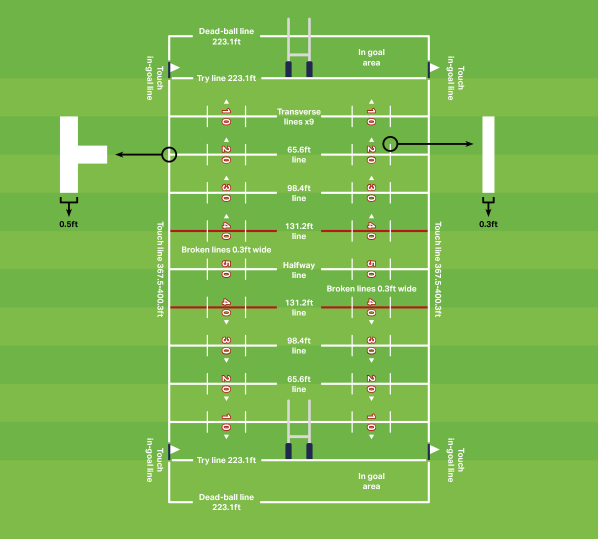
Rugby league pitch lines in feet
Rugby league pitch line markings in feet are:
- Touchlines (x2): 367.5-400.3ft long; 0.5ft wide
- Dead-ball lines (x2): 223.1ft long; 0.5ft wide
- Try lines (x2): 223.1ft long; 0.5ft wide
- Transverse lines (x9): 223.1ft long; 0.5ft wide
- Broken lines (x4): 328.1ft long; 0.3ft wide.
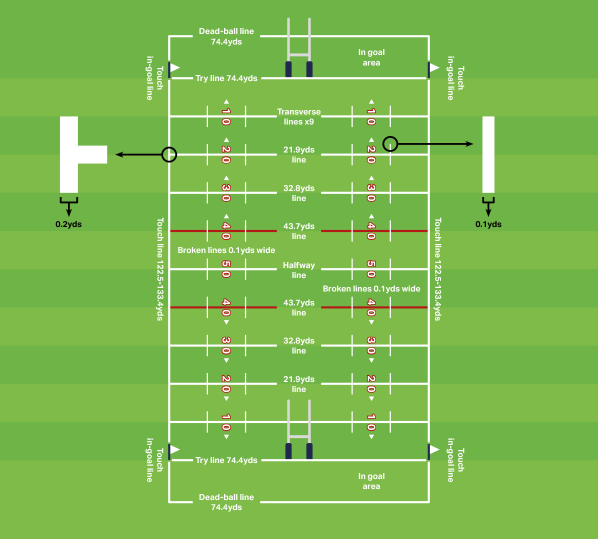
Rugby league pitch lines in yards
Line markings for rugby league pitches in yards are:
- Touchlines (x2): 122.5-133.4yds; 0.2yds wide
- Dead-ball lines (x2): 74.4yds; 0.2yds wide
- Try lines (x2): 74.4yds; 0.2yds wide
- Transverse lines (x9): 74.4yds; 0.2yds wide
- Broken lines (x4): 109.4yds; 0.1yds wide.
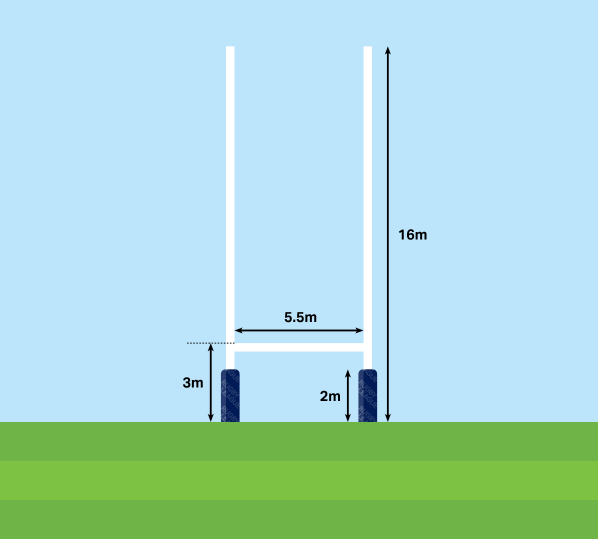
Rugby League Post Dimensions
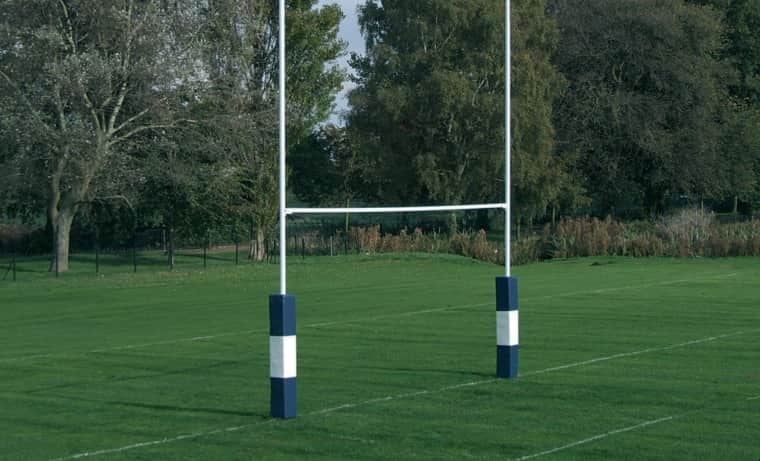
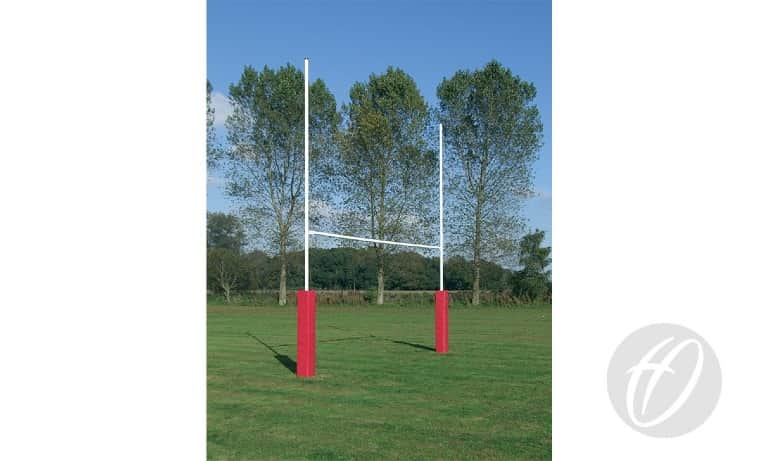
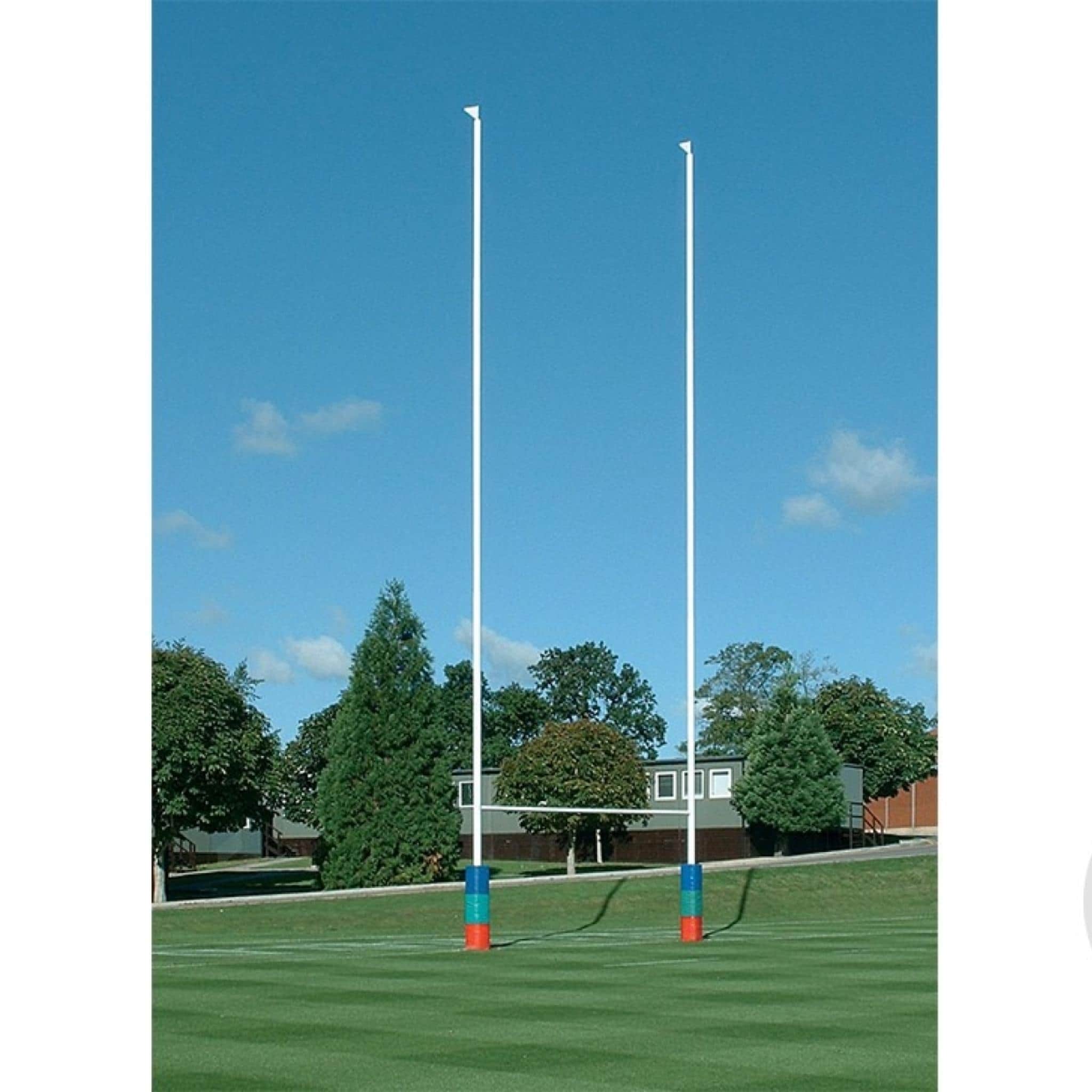
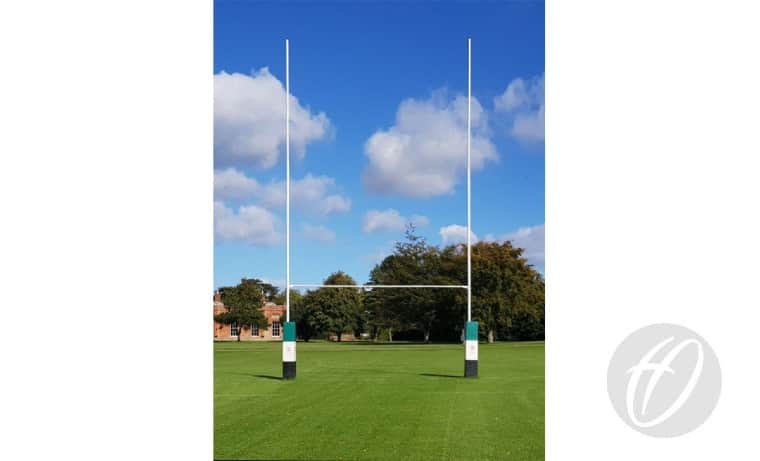
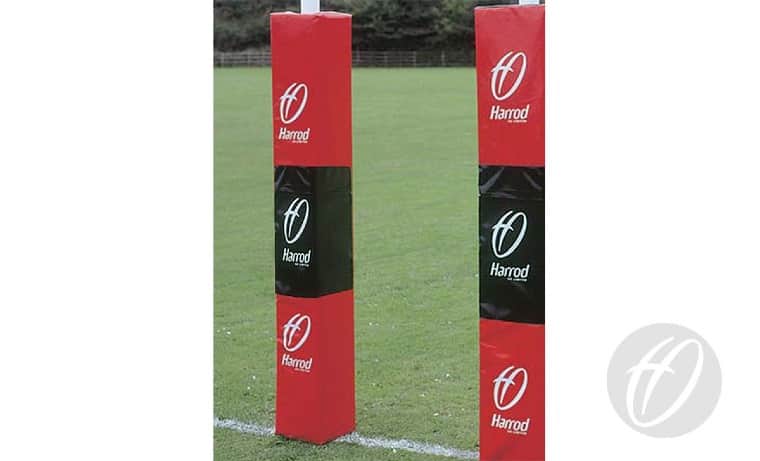
An H-shaped goal post stands at the centre of each try line. Each goal post comprises two vertical posts, 5.5m (18.1ft) apart, at a minimum height of 16m (52.5ft). The crossbar is 3m (9.8ft) from the top of the crossbar to the ground. It's recommended that the bottom 2m of the goal posts are padded for the players' protection.
At the points where the touchlines and try lines meet, there are non-rigid corner posts at least 1.3m (4.1ft) high. These corner posts act as touchlines and are therefore considered to be in touch, meaning that if a ball-carrier touches a corner post, he halts play.
Did you know that we make rugby posts and equipment for many of the professional clubs? You can view our full rugby equipment range here.