




Basketball Court Size Dimensions and Markings

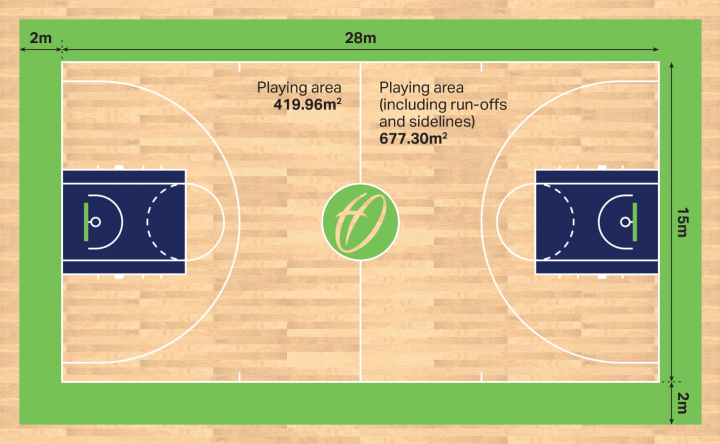
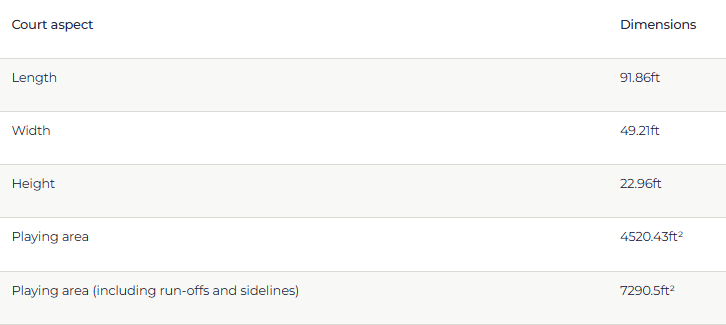
The playing area of a basketball court in the UK is 91.8ft (28m) in length and 49.21ft (15m) wide. Indoor courts should be 22.96ft (7m) in height.
Sport England's requirements are split into four levels of play: International, Premier (national competition), Club (regional competition) and Community (schools/recreational). This allows courts to be more flexible with sizes. The dimensions of a basketball court in these cases also include a minimum length and width: 85.3ft (26m) x 45.93ft (14m).
How long is a basketball court?
The length of a basketball court is 28m. These measurements can be reduced to 26m for Premier, Club and Community courts where only smaller spaces are available.
How wide is a basketball court?
The width of an International-standard basketball court in the UK is usually 15m. The court lines can be reduced by no more than 1m (14m) if required for lower levels of play.
What is the total area of a basketball court?
The total area of a professional basketball court is 420m². The minimum area allowed under Basketball England's guidance is 364m². These measurements apply to both indoor and outdoor courts.
The addition of 2.05m run-offs and 2m for teams and officials on the sideline increases the total area to 677.31m².
Basketball court dimensions in feet
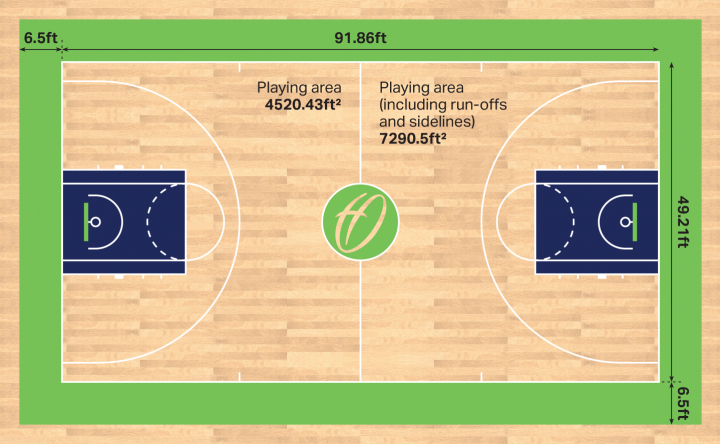
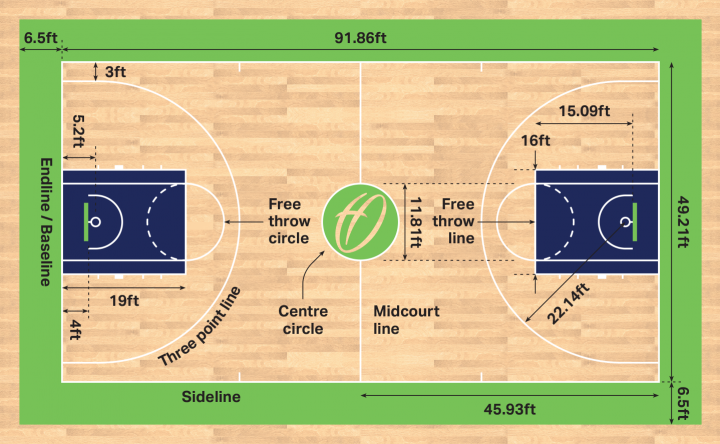
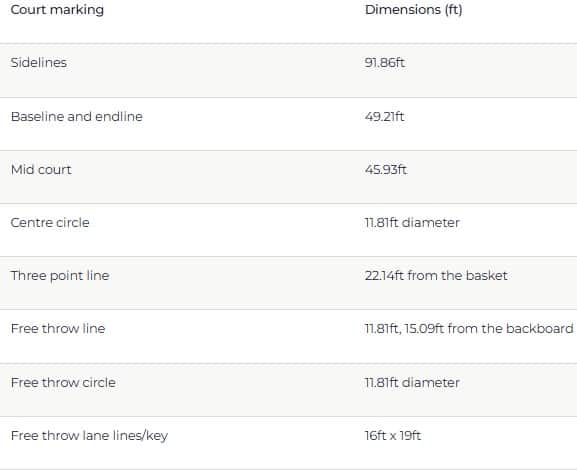
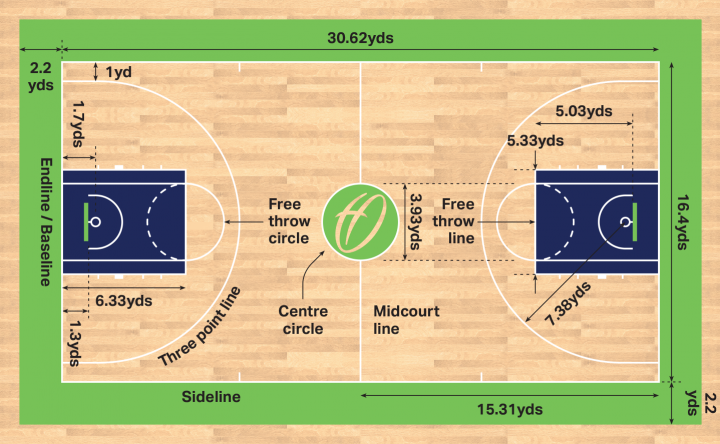
A basketball court is 91.86ft long and 49.21ft wide. The total playing area for a court is 4520.43 ft² and 7290.5ft² if run-offs and sidelines are required.
Basketball court dimensions in yards
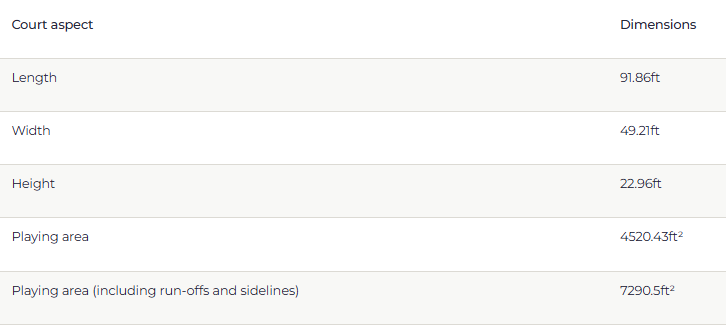
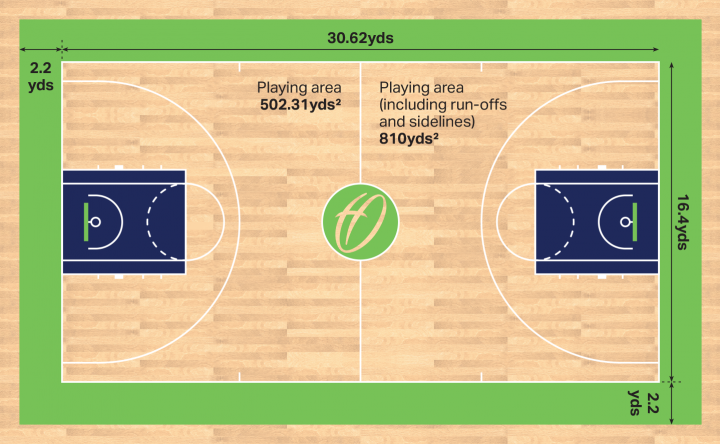
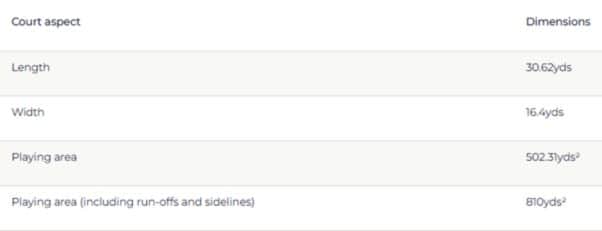
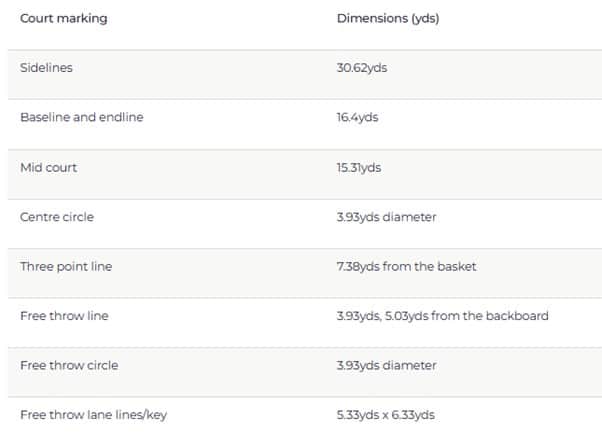
A basketball court is 30.62 yards long, and 16.4 yards wide. The total playing area for a court is 502.31yds² and 810yds² if run-offs and sidelines are required.
Basketball court markings
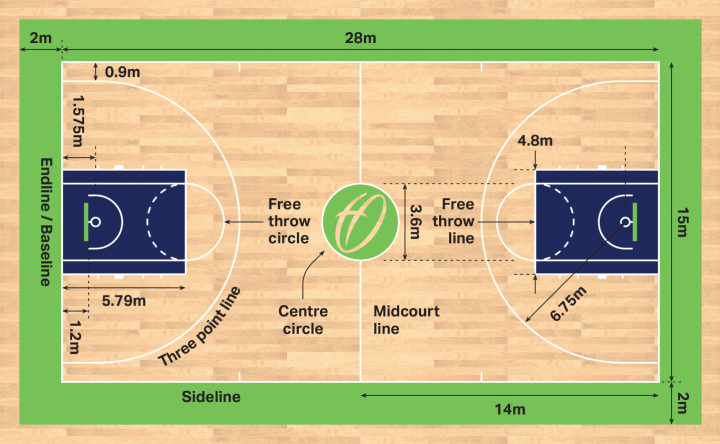
Regulation line markings must be 50mm width in a contrasting colour to the playing surface.
Sidelines
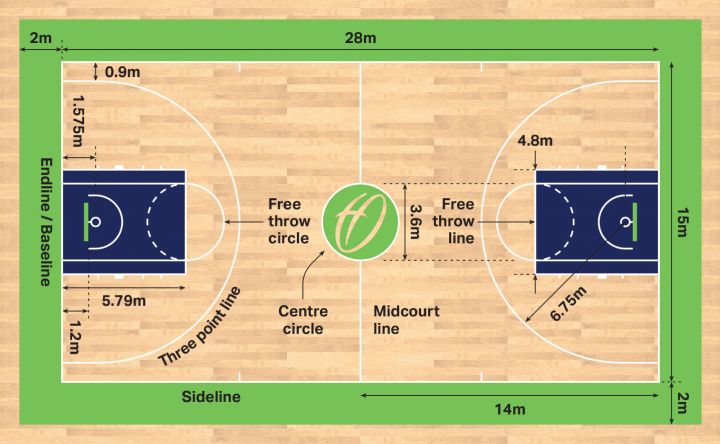
The outer edge of the court is denoted by the sidelines, which run the length of the court. On a full-sized court they measure 28m.
Baseline and endline
The terms baseline and endline both refer to the ends of the court running behind the goals. Typically they measure 15m.
The use of the different terms depends on the direction a team is playing. Endline is the term for the end of the court which a team is defending, baseline is the for the attacking end.
Mid court
This is the halfway mark on the court and is used to denote the offensive playing area during a game.
On a full-sized court, the mid court line would be 14m from each endline.
Centre circle
Used for the opening tip off, the centre circle has a 3.6m diameter.
Three point line
The three point lines are the arcs that mark a range boundary from each hoop. Scoring from outside this line is worth three points. The distance of the line will vary depending on the level of game, but is typically 6.75m from the basket.
Free throw line
The free throw line, marked 4.6m from the backboard, is the mark at which a player must stand when shooting free throws.
Free throw circle
The free throw circle is the same size as the centre circle (3.6m in diameter). Shooters must stay inside this circle when taking a free throw. The circle is also used for jump balls.
Free throw lane lines/key
Lane lines run from the free throw line to the baseline, to form the 'key'. The shape and width can vary depending on the level of the game, but FIBA (International Basketball Federation) regulation changes in 2010 set it as a 4.9m by 5.8m rectangle.
Some also include space markings to keep opposing players from obstructing the free throw shooter.
Basketball court lines in feet and yards
Basketball court lines in metres
Basketball goal dimensions
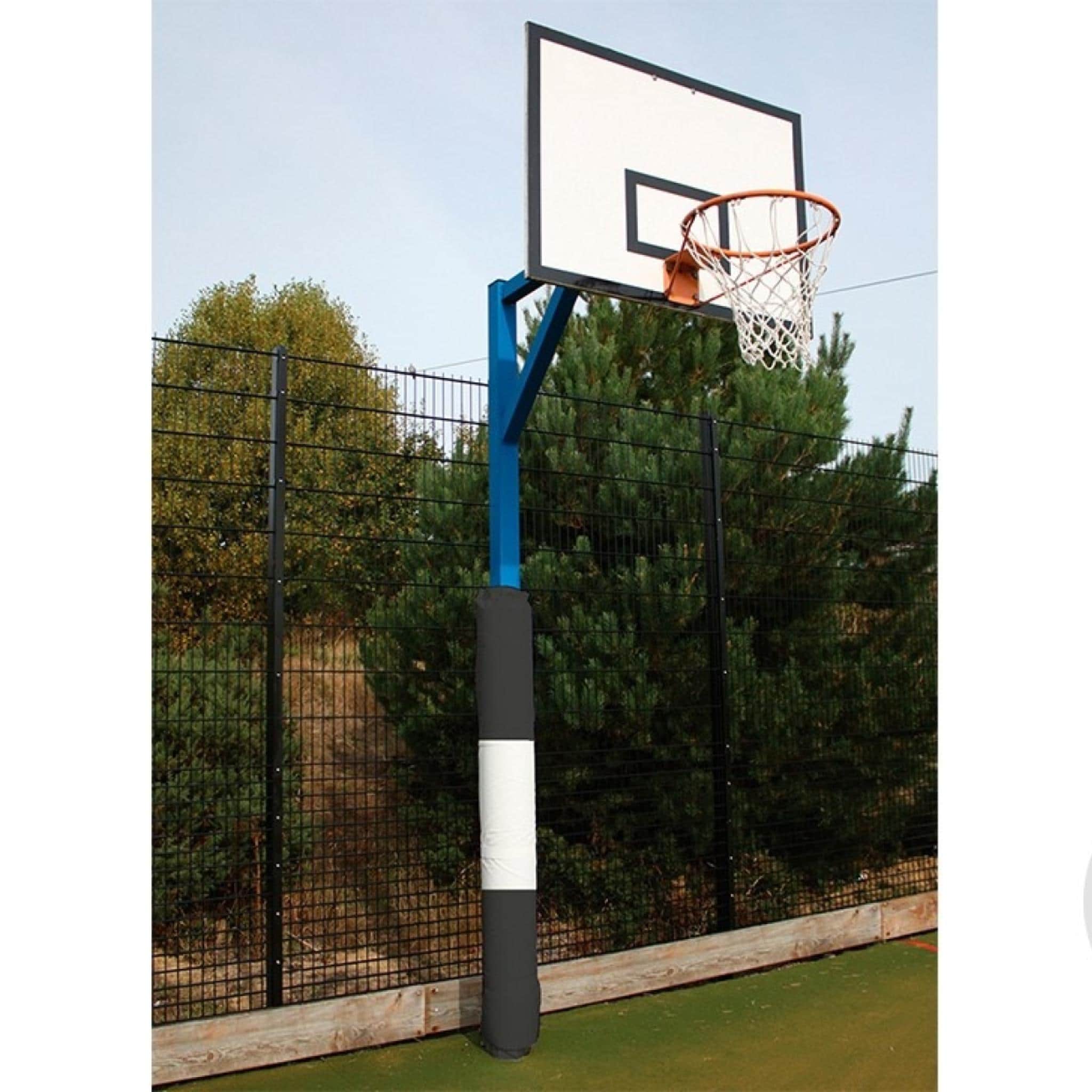
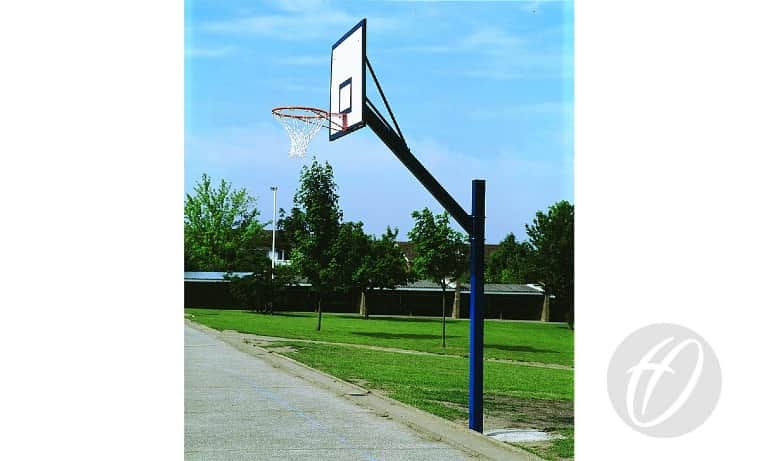
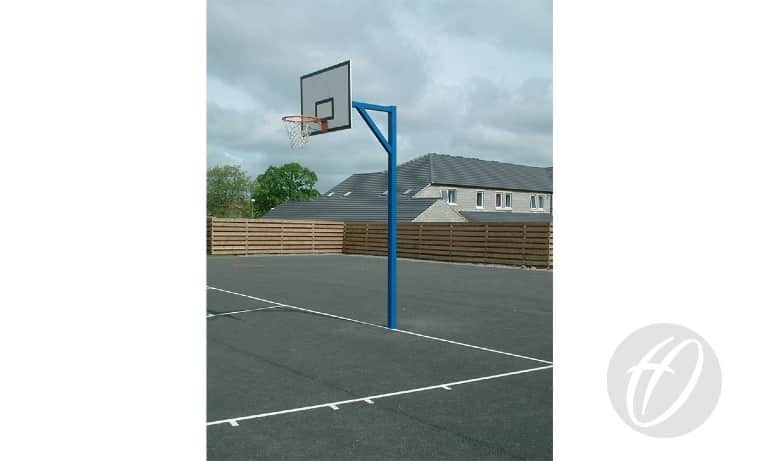
A number of basketball goal systems are available: wall hinged, ceiling mounted or free-standing practice goals.
Backboards
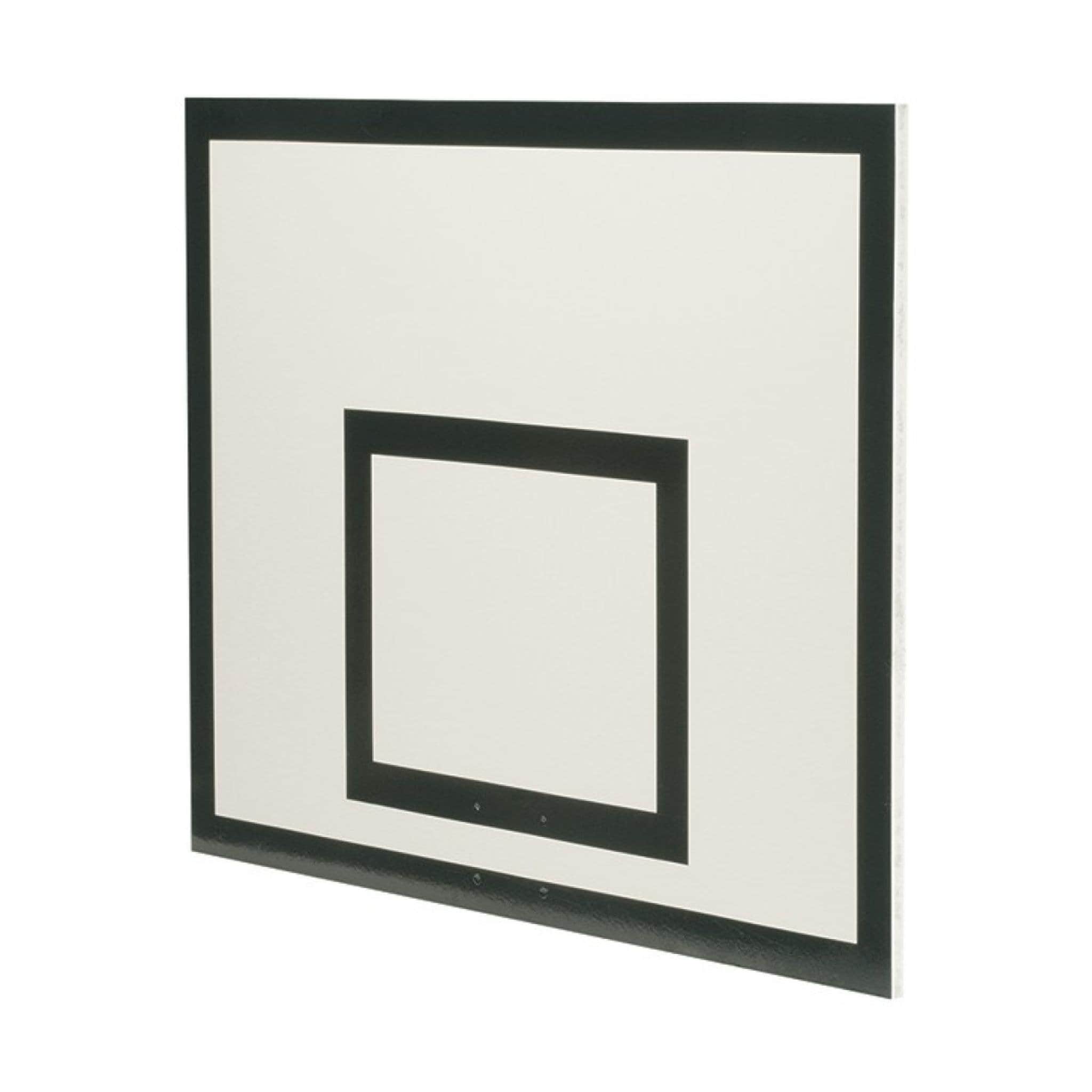
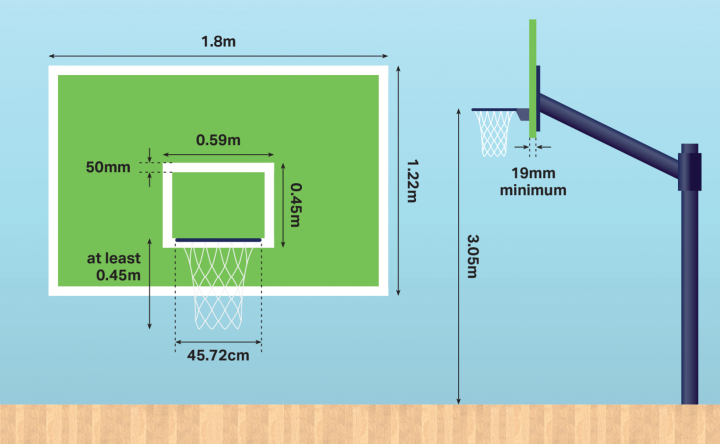
Backboard dimensions are 1.8m x 1.22m, with a minimum thickness of 19mm. Backboards can be made of either timber or transparent material and must be fitted with padding at all levels above U16.
Backboard line markings should be 50mm in width and either black or white, depending on the material of the board. The inner rectangle should measure 0.45m x 0.59m.
Goals
The basketball goal (also known as a ring or hoop) is typically 18 inches (45.72cm) in diameter and must be positioned 3.05m from the floor.
Nets are typically white and suspended from the ring. They should be no shorter than 45cm.
Download the PDF
The images and diagrams showing the dimensions of a basketball court in this article are available in a downloadable PDF
Check out our range of basketball equipment, including goals, backboards and accessories.